Trust is a record-keeping problem.

Trust in coffee is usually sold as a feeling. Warm words about farmers, a photograph of a hillside. A buyer purchasing Ethiopian coffee through an importer typically receives four facts: origin region, grade, process, crop year. Everything else is an assertion. Nobody is necessarily lying. There is simply no instrument between the claim and the buyer.

First
You cannot verify what you bought. Grade 2 washed Yirgacheffe describes a category, not a lot. Screen size and defect count are what the paperwork records, and neither predicts how it cups or how it holds for six months.
Second
You cannot prove what went wrong. Coffee that arrives flat is usually not a farm problem, but without a record of the voyage there is no way to establish that, and no way to hold anyone to it.
Third
You cannot buy it again. This is the one that costs money. A roaster who nails a single origin, builds a menu around it, and then cannot source the same thing next season has a business problem. Without a record precise enough to repeat, every good lot is an accident.

The record, as a document.

Every reading is printed against the band it has to sit inside, so the number can be checked rather than believed. Below is a specimen, printed to show the format. It is not an available lot, and the two links still in build are shown as empty rows rather than quietly left out.

Specimen · not an available lot

Washed Yirgacheffe · Grade 1

Format only
Stationnamed on the record
ZoneGedeo
Delivery datedated on the record
HarvestOct to Jan
Processwashed
Cultivarheirloom
CupperQ-grader, named
Scoresheetattached
Moisture 10.8% spec · under 11.5% · scale 8 to 13
Water activity 0.58Aw spec · 0.45 to 0.65 · scale 0.35 to 0.75
Screen size 15/16 spec · 12 to 18 · 91% retention · scale 10 to 20
Defect count 2/300g Grade 1 · 0 to 3 full defects · scale 0 to 12
Cup score 86.25 specialty · 80 and above · scale 75 to 92
Voyage record in build no device selected · we will not print a reading we cannot take
Plot geolocation in build EUDR · depends on station data · applies 30 December 2026

“If a sentence could survive being false, it is the wrong sentence.”

That is the writing rule behind every lot document we produce. Moisture 10.8 and water activity 0.58 can be checked. Carefully selected cannot. So we publish the reading and leave the adjective out.

Why Ethiopia, and why now.

This is not a generic traceability pitch. Ethiopia has a particular history that makes the gap real, and a particular deadline that makes it urgent.

Lot identity was structurally erased

For years the commodity exchange bulked coffee by grade and region. Good for price discovery, fatal for knowing which washing station a bag came from. Vertical integration, reformed in 2017 and expanded since, lets an exporter keep a lot intact from station to container. That transition is recent and incomplete.

ECX era · bulked by grade · reform ongoing
The exporter bar just rose

Minimum exporter capital moved from 1 million birr to 15 million, and every licensed exporter now needs a certified lab and a certified taster. Anyone still licensed has cleared a materially higher bar than a year ago. A buyer abroad has no way to see that from where they sit. We do, because we work on the origin side of it.

15M birr minimum · certified lab · certified taster

EUDR arrives 30 December 2026

Buyers selling roasted product onward into the EU will need geolocation data for the plot the coffee came from. Most Ethiopian supply chains are not ready for that, and the deadline does not move again.

Geolocation to the plot · deadline fixed

Transit is unmeasured

Day and night temperature swings inside a steel container move moisture between the beans, the air and the walls. It condenses and drips back onto the bags. Published work links transit conditions to moisture change and ochratoxin A. Almost nobody measures it.

Container rain · moisture migration · unmeasured

Your own eyes on the container.

A broker asks you to take their word for it. We are building the alternative: a shipment that travels instrumented, recording where it is, how warm it got and how wet the air became, from the washing station to your warehouse door. Commissioned by you, delivered to you, unedited. Here is the design, stated plainly, including the part that runs today and the part that does not yet.

Prevention, specified

Most transit damage is condensation, not theft. Before the container is sealed we specify the defence: hermetic liners inside the jute, calcium chloride desiccant sized to the load, moisture and water activity confirmed at origin. This part runs today.

Running now · liner · desiccant · moisture checked

The container, instrumented

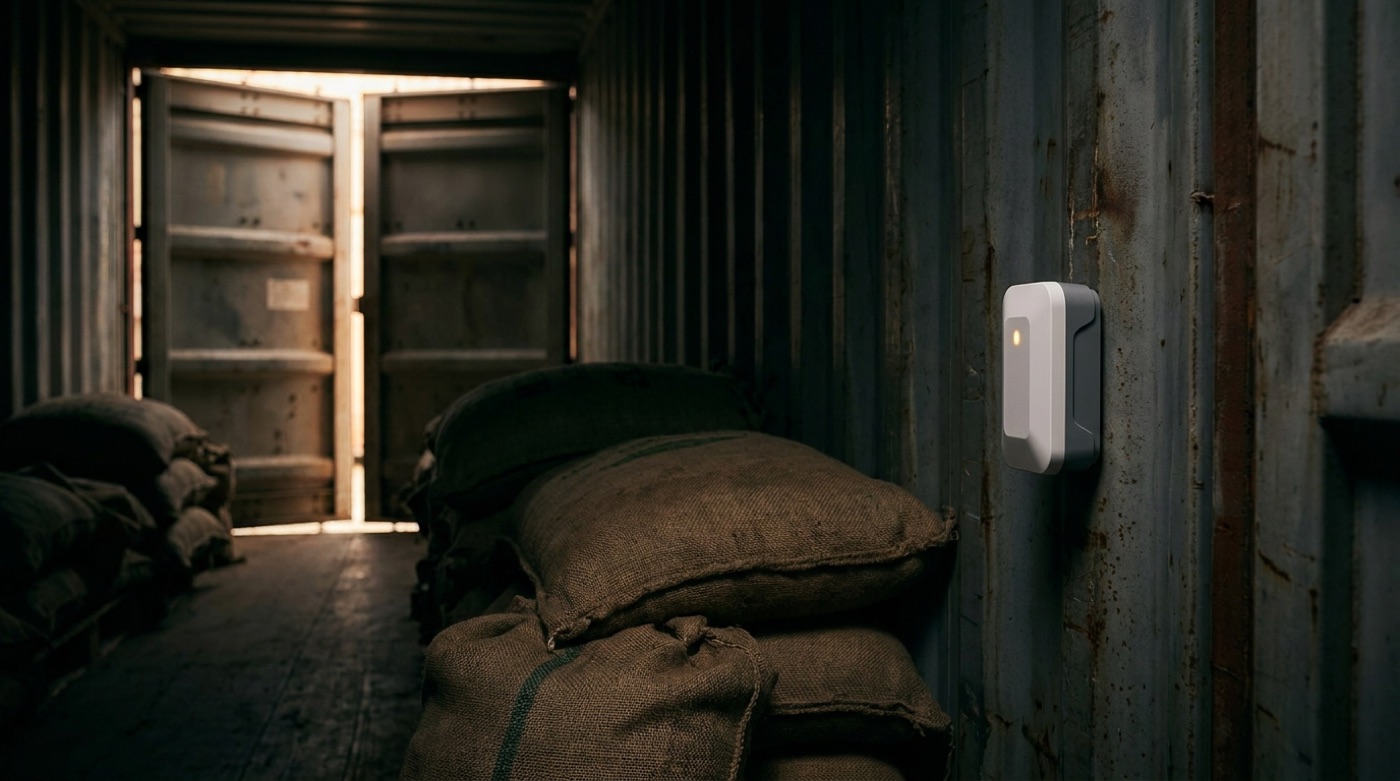
The specification calls for sensors with the cargo and on the door: position, temperature, humidity and every opening, recorded continuously rather than sampled at each end. No device has passed our selection yet, and we will not name one until it has.

In build · location · temperature · humidity · door events

The record, handed over

What the finished service will hand you: the complete curve for the voyage alongside the export documents. Evidence you could put behind a quality claim, an insurance dispute, or your own incoming QC file.

In build · full voyage curve · yours to keep

Independent by construction. When container monitoring runs, it will be commissioned per container and quoted per shipment, by you, not by the exporter. The readings will go to the buyer who paid for them, unedited, and we will run it on lots we did not source just as readily as on lots we did. There is no cellular network in the middle of an ocean and we will not tell you otherwise: the design records on board for the whole crossing and uploads the complete voyage at the destination port. Until it runs, what you get today is the pre-shipment condition report: moisture, water activity and the sealing specification, measured before the doors close.

Ask us for the evidence, not the pitch.

Send a brief and we reply with lots and the documentation behind them. If a question on this page matters to your buying, ask it directly and you will get a direct answer.

Jute coffee sacks inside a shipping container with a monitoring device mounted on the wall
Container monitoring · in build