Brazil Arabica cycle: why every importer watches Minas Gerais.
Brazil Arabica cycle in 21 years of USDA data: Brazil set the direction of world Arabica in 20 seasons. Who filled its 2021 to 2025 gap, and what to check next.
In 20 of the last 21 seasons, world Arabica output moved in the same direction as Brazil's. We took the year-on-year change in both series from the USDA's PSD database for 2005/06 to 2026/27. The correlation is 0.97. Brazil's average swing was 7.0 million bags a year, against 8.0 million for the world. The one exception was 2024/25, when Brazil slipped 0.4 million bags and other origins added 5.5 million. When Brazil's Arabica fell 11.7 million bags between 2020/21 and 2025/26, the rest of the world replaced about a third of it, and Ethiopia supplied almost all of that net gain.
Why Brazil's trees move together
The USDA explains the mechanism in its July 2026 report. Brazilian Arabica grows on plateaus and rolling hills with fairly uniform weather. A frost, heat or drought pushes large areas into an off-year at the same time, and mechanised pruning and harvesting line output up further. Under normal conditions an on-year can rise 5 to 10 million bags and fall by a similar amount the next year.
Geography concentrates the risk. The USDA's Brazil post, citing Conab, puts Minas Gerais at almost 72 percent of Brazil's Arabica. Conab's September 2026 survey calls 2026 a positive biennial year: Arabica at 48.2 million bags, up 34.8 percent, and Minas Gerais at 35.6 million bags of all coffee, up 38.2 percent.
Brazil against everyone else, season by season
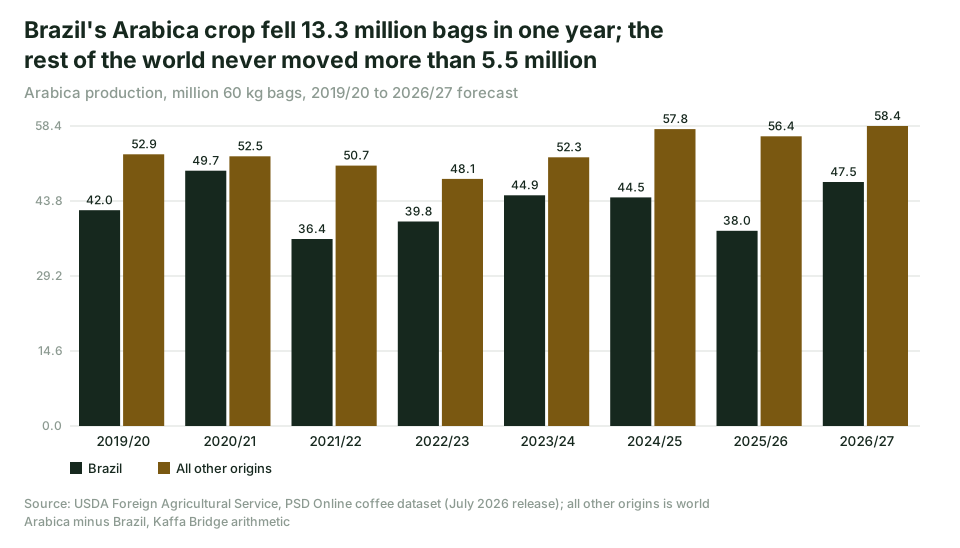
| Season | Brazil Arabica, million bags | Change | All other origins | Change |
|---|---|---|---|---|
| 2019/20 | 42.0 | -7.7 | 52.9 | -2.3 |
| 2020/21 | 49.7 | +7.7 | 52.5 | -0.5 |
| 2021/22 | 36.4 | -13.3 | 50.7 | -1.8 |
| 2022/23 | 39.8 | +3.4 | 48.1 | -2.6 |
| 2023/24 | 44.9 | +5.1 | 52.3 | +4.2 |
| 2024/25 | 44.5 | -0.4 | 57.8 | +5.5 |
| 2025/26 | 38.0 | -6.5 | 56.4 | -1.3 |
| 2026/27 forecast | 47.5 | +9.5 | 58.4 | +1.9 |
"All other origins" is world Arabica minus Brazil, our arithmetic. Read the 2021/22 row. Brazil lost 13.3 million bags to drought and heat, and the rest of the world fell too. Other origins did not respond in the same season. Their gains came two and three years later.
Who filled the gap
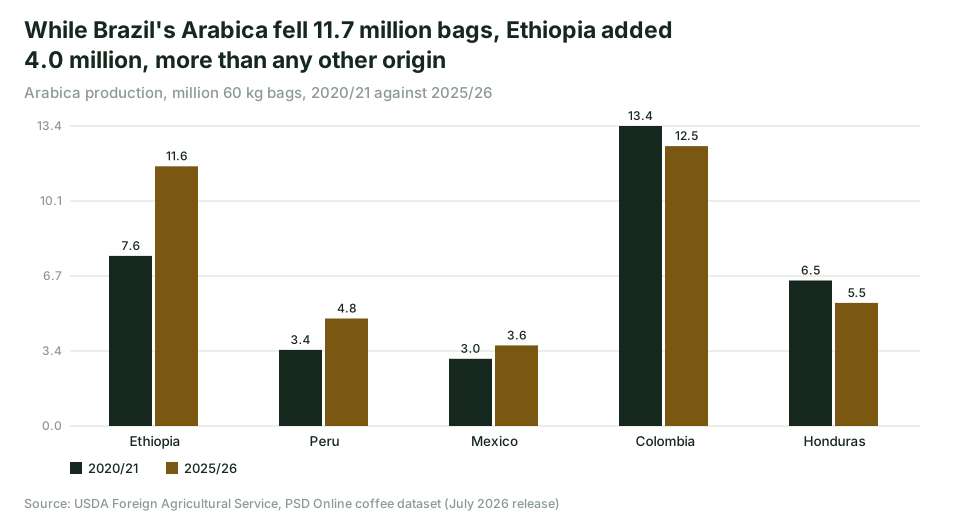
From 2020/21 to 2025/26, Ethiopian Arabica rose from 7.6 to 11.6 million bags, a gain of 3.96 million. Peru added 1.40 million and Mexico 0.58 million. Colombia lost 0.90 million and Honduras 0.97 million. The net gain outside Brazil was 3.99 million bags, so Ethiopia's increase matched it almost exactly. The USDA says these gains did not fully compensate for Brazil, and world ending stocks fell 15.5 million bags between 2020/21 and 2024/25.
Three official counts of one harvest
The agencies agree on Arabica and split on Robusta. For 2026/27 the USDA has 47.5 million bags of Arabica and 71.9 million in total. Conab has 48.2 million Arabica but 67.6 million in total, because its Robusta figure is 19.4 million against the USDA's 24.4 million. The ICO cites 46.3 million Arabica and 71.4 million in total. We use the USDA series here because it runs back consistently for every origin. The USDA's Brazil post notes that Conab and IBGE use different methods and have historically come in lower.
These figures cannot be read as one calendar harvest: Brazil's marketing year runs July to June and Ethiopia's October to September, and the USDA revises past seasons.
Five readings before the next contract
- Conab's next survey. Compare its Arabica number with 48.2 million bags. A cut would point to losses from harvest rain, which Cecafe already says hurt the quality of early Arabica lots.
- The USDA release on 16 December 2026. Check Brazil Arabica against 47.5 million bags and world ending stocks against 26.3 million.
- Cecafe's monthly exports. September 2026 was 3.894 million bags, up 3.1 percent. July to September totalled 11.21 million, up 15.5 percent. A slowdown would mean new-crop coffee is reaching the market later than the forecast implies.
- ICE certified Arabica stocks. The ICO reports 217,646 bags on 15 September, the lowest since 1999, rising to 260,654 bags by 30 September.
- 2027/28. Our inference, not an agency forecast: on the biennial pattern it would be an off-year. Size any second-origin plan against the USDA's normal fall of 5 to 10 million bags, not against this year's record.
Kaffa Bridge acts for buyers who want that second origin to be Ethiopia. Orders start at one full container load; prices are on enquiry, FOB Djibouti or CFR your port.
Sources
- USDA Foreign Agricultural Service, PSD Online coffee dataset, July 2026 release
- USDA Foreign Agricultural Service, Coffee: World Markets and Trade, July 2026
- USDA FAS GAIN, Brazil Coffee Annual, BR2026-0025, 1 June 2026
- Conab, Acompanhamento da safra brasileira de cafe, 3rd survey, September 2026
- International Coffee Organization, Coffee Market Report, September 2026
- Cecafe, Relatorio Mensal, September 2026