World coffee supply 2026/27: a record crop that barely refills stocks.
World coffee supply 2026/27: a record crop lifts stocks to only 14.6 percent of a year's use, against 23.1 percent in 2020/21. What it means and what to check.

A record crop of 189.7 million bags adds only 1.9 million bags to world coffee stocks. That leaves ending stocks in 2026/27 at 14.6 percent of a year's consumption, about 7.6 weeks of use, on the USDA's July 2026 figures. In the five seasons to 2020/21 the same ratio ran between 19.9 and 23.5 percent. Its 2024/25 low, 12.8 percent, is the lowest in the USDA series since at least 2005. To get back to the 2020/21 ratio of 23.1 percent at today's consumption, the world would need 41.6 million bags in stock, 15.3 million more than forecast. The ratios are our arithmetic: ending stocks divided by consumption.
Stocks measured against use
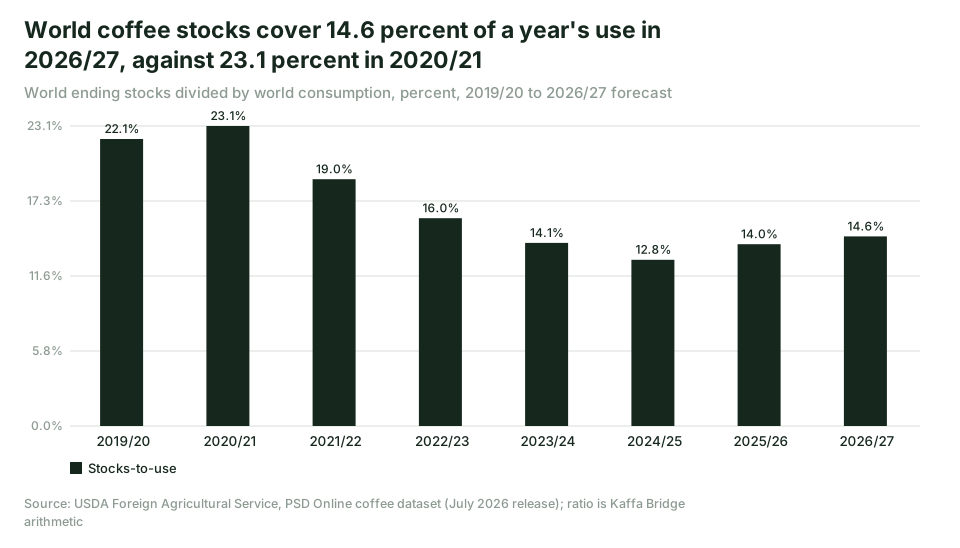
| Season | Ending stocks, million bags | Consumption | Stocks-to-use, percent | Weeks of use | World Bank Arabica, calendar-year average, US$/kg |
|---|---|---|---|---|---|
| 2020/21 | 37.5 | 162.1 | 23.1 | 12.0 | 3.32 (2020) |
| 2021/22 | 31.9 | 167.9 | 19.0 | 9.9 | 4.51 (2021) |
| 2022/23 | 26.9 | 168.8 | 16.0 | 8.3 | 5.63 (2022) |
| 2023/24 | 23.1 | 163.9 | 14.1 | 7.3 | 4.54 (2023) |
| 2024/25 | 22.0 | 171.8 | 12.8 | 6.7 | 5.62 (2024) |
| 2025/26 | 24.4 | 173.5 | 14.0 | 7.3 | 8.47 (2025) |
| 2026/27 forecast | 26.3 | 179.7 | 14.6 | 7.6 | not yet |
As the ratio fell from 23.1 to 12.8 percent, the World Bank's annual Arabica average rose from $3.32 to $5.62 a kilo, then reached $8.47 in 2025. This is co-movement, not a model. Calendar years do not match marketing years, and 2023 broke the pattern with a lower price. The agencies describe the same direction in words. The USDA says prices fell 25 percent in seven months as additional supplies became available. The World Bank expects Arabica to fall 14 percent in 2026 after rising more than 40 percent in 2025, on recovering supply.
Why production minus consumption misleads
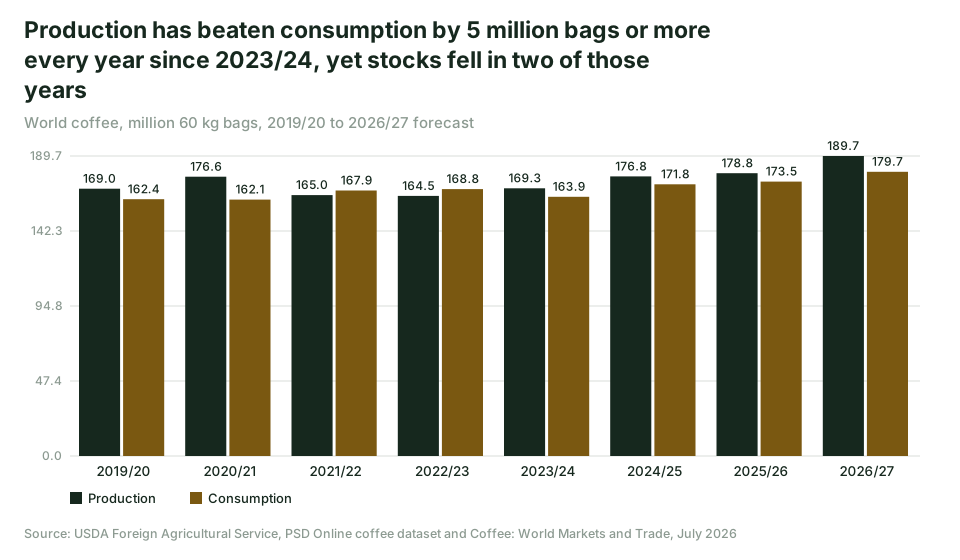
On USDA numbers, production beat consumption by 5.4, 5.1 and 5.4 million bags from 2023/24 to 2025/26, and is forecast to beat it by 9.9 million in 2026/27. Yet stocks fell 3.8 million bags in 2023/24 and 1.1 million in 2024/25. The USDA balance also counts trade, and recorded world exports exceed recorded imports. In 2024/25, exports were 147.7 million bags and imports 141.6 million.
The ICO counts the same years differently. Its September 2026 report shows deficits in every coffee year from 2021/22 to 2024/25, of 8.4, 3.7, 3.0 and 6.3 million bags, then a surplus of 3.0 million in 2025/26. The ICO notes that this surplus is less than one week of world consumption. The two agencies disagree on the gap, so we rely on the USDA stock series, which both sets of figures support in direction: stocks drew down through 2024/25.
Read the ratio as a trend, not a warehouse count: the world figure sums country estimates on different marketing years and covers only stocks the USDA tracks.
Four record crops
The USDA names record crops in Brazil (71.9 million bags), Vietnam (32.5 million), Ethiopia (12.1 million) and Uganda (7.16 million), partly offset by lower output in India and Indonesia. Arabica is 105.9 million bags, 55.8 percent of the total, our arithmetic. Consumption is forecast at a record 179.7 million bags, with the largest gains in the European Union and the United States.
The ICO's September 2026 report puts its composite indicator at 262.18 US cents per lb, down 8.7 percent on August. World exports of all forms of coffee were 12.55 million bags in August 2026, against 10.95 million a year earlier, and 130.74 million for the coffee year to August, up 1.0 percent.
Dates and thresholds for the next quarter
- USDA, 16 December 2026. Compare world ending stocks with 26.3 million bags. Below about 23 million, the ratio would fall under the 2024/25 low of 12.8 percent at forecast consumption.
- ICE certified Arabica stocks. The ICO reports 217,646 bags on 15 September, the lowest since 1999, and 260,654 by 30 September. Further rises mean Brazil's harvest is reaching the exchange.
- The ICO composite. Check October against 262.18 cents.
- El Nino. The ICO cites NOAA's 10 September outlook of a better than 90 percent chance of a very strong event. The World Bank names El Nino as a risk that could tighten markets again.
Sources
- USDA Foreign Agricultural Service, PSD Online coffee dataset, July 2026 release
- USDA Foreign Agricultural Service, Coffee: World Markets and Trade, July 2026
- International Coffee Organization, Coffee Market Report, September 2026
- World Bank, Commodity Price Data (Pink Sheet), annual nominal prices
- World Bank Data Blog, Beverage prices retreat as supplies recover, 7 July 2026