Ethiopian coffee production 2026/27: a record crop, and where the extra bags go.
Ethiopian coffee production hits a record 12.1 million bags in 2026/27, yet bean exports sit below 2024/25. USDA data show where the extra coffee goes.

Ethiopian coffee production is forecast at a record 12.1 million 60 kg bags in 2026/27, but the extra coffee is not reaching the export market. Since 2024/25 the USDA adds 640,000 bags of production and 1.0 million bags of Ethiopian home consumption. Bean exports are forecast at 7.1 million bags, 310,000 below the 2024/25 record. The share of the crop shipped as green beans falls from 64.7 percent to 58.7 percent, almost exactly the 59.3 percent of 2021/22. All shares here are our arithmetic from the USDA figures.
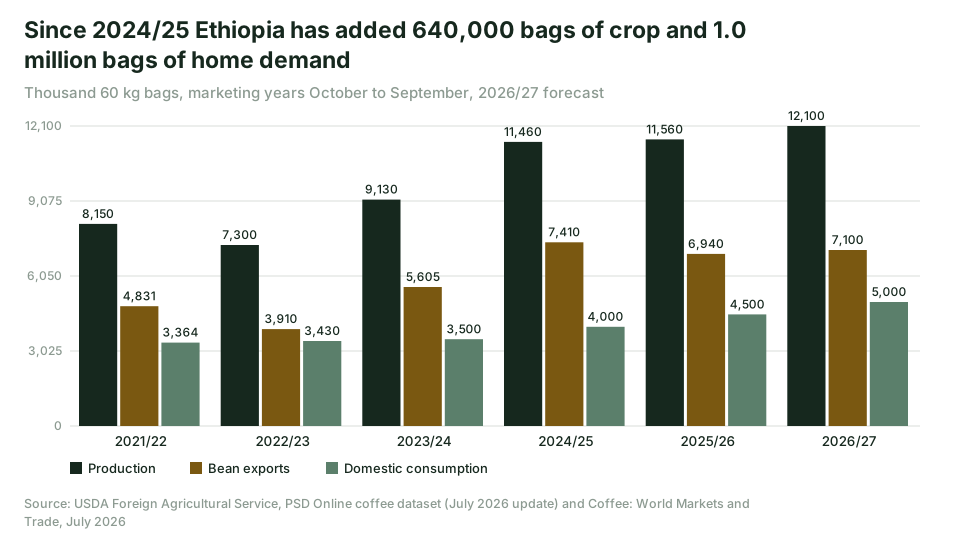
Two seasons, one balance sheet
| Thousand 60 kg bags | 2024/25 | 2026/27 forecast | Change |
|---|---|---|---|
| Production | 11,460 | 12,100 | +640 |
| Bean exports | 7,410 | 7,100 | -310 |
| Domestic consumption | 4,000 | 5,000 | +1,000 |
| Ending stocks | 80 | 145 | +65 |
Over the full five years the three lines grew almost in step: production up 48 percent, bean exports up 47 percent, home use up 49 percent. The 2024/25 export share was the outlier year. Brazil's home use, by contrast, barely moved over the same seasons (Ethiopia vs Brazil).
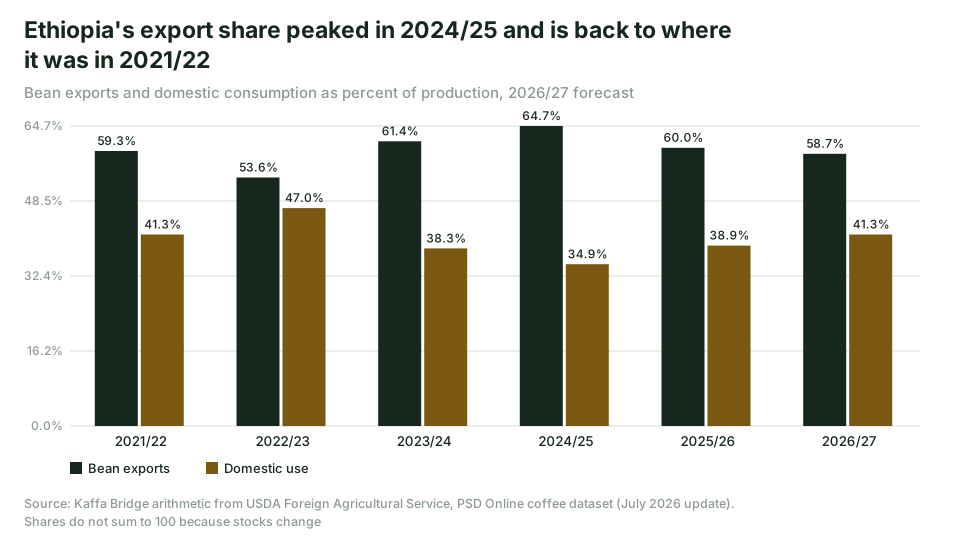
Area or yield
The USDA office in Addis Ababa puts harvested area at 730,000 hectares in 2023/24 and 800,000 in 2026/27. Production over the same years rises from 9.13 to 12.1 million bags, so implied yield moves from 0.75 to 0.91 tonnes per hectare. Area rose 9.6 percent and yield 20.9 percent: roughly two thirds of the growth is yield. The office credits stumping of old trees, which covered 15 percent of harvested area in 2025/26 according to ECTA, and improved seedlings.
The Ethiopian Coffee and Tea Authority gives a much larger number. Its July 2026 briefing, reported by Xinhua, put production at 1.5 million tonnes, about 25 million bags. The USDA estimate for 2025/26 is about 694,000 tonnes. We use the USDA figure because its balance closes: exports plus home use plus stocks equal the crop.
Why the home market pulled ahead
The USDA raised its 2025/26 consumption estimate from 3.70 to 4.50 million bags, saying falling world prices redirect supply to the home market, where local prices remain higher than international ones. It points to cafe growth in cities and younger drinkers, even with retail bean prices more than 90 percent above previous years.
The export side was squeezed at the same time. Cooperatives in Yirgacheffe reported red cherry at 220 to 250 birr per kilogram in December 2025, nearly four times the previous season. The average export price rose far less: 331 US cents per lb in January 2026 against 238 a year earlier, up 39 percent. Exporters cut cherry buying and held stock, and the USDA cut 2025/26 total exports from 7.80 to 6.97 million bags.
ECTA's own figures fit this picture. It reported a record 3 billion US dollars of export earnings at 7,500 dollars a tonne, which implies about 400,000 tonnes or 6.7 million bags, on the Ethiopian fiscal year to July.
The consumption series is a USDA estimate, not a survey, and no Ethiopian body publishes a matching balance sheet.
What would change this picture
- The December revision. The USDA's next coffee report is due on 16 December 2026. A bean export figure below 7.1 million bags means home demand has taken more again.
- The spring pace. May, June and July have averaged 12, 13 and 12 percent of annual exports. At 7.1 million bags, a 12 percent month is about 850,000 bags. Ask your exporter how their own shipments track against last spring.
- Washed volume. Washed supply tightened in 2025/26 as farmers dried cherry at home. Confirm washed tonnage in writing before you price a washed lot.
- EU dates. The deforestation regulation applies from 30 December 2026 for large and medium operators and 30 June 2027 for micro and small, per the European Commission. Ask whether each lot's plots are in ECTA's national traceability system.
Kaffa Bridge acts for buyers sourcing in Ethiopia and does not export coffee itself. Lots start at one full container, priced on enquiry FOB Djibouti or CFR your port.
Sources
- USDA Foreign Agricultural Service, Coffee: World Markets and Trade, July 2026
- USDA Foreign Agricultural Service, PSD Online coffee dataset (July 2026 update)
- USDA FAS Addis Ababa, Ethiopia Coffee Annual, ET2026-0005, 20 May 2026
- USDA FAS Addis Ababa, Ethiopia Coffee Annual, ET2025-0014, 3 June 2025
- Xinhua, reported by The Star, 5 July 2026: Ethiopia earns record 3 bln USD from annual coffee exports (ECTA figures)
- European Commission, Regulation on deforestation-free products